How Exceptional Capital automates portfolio admin to save 5+ hrs/week


Melissa Aurigemma is Chief of Staff at Exceptional Capital, a pre-seed and seed stage fund supporting ~30 companies with 4 team members.
Hear how Cura transformed her portfolio admin work within 48 hours of onboarding and saved her 5+ hours a week.
Exceptional Capital is a 4-person fund supporting ~30 portfolio companies. After two years trying to build their own internal Slack bot for portfolio context, they adopted Cura in early 2026 and had the whole team using it within 48 hours.
What changed:
- Onboarding took 24 to 48 hours. Tag @Cura into Slack, add domains, forward a few emails, connect Granola, share the metrics sheet. That was it.
- Portfolio admin prep used to start with 30 to 60 minutes of digging through Slack, email, WhatsApp, and Sheets. Now it’s a single @Cura query. Melissa is getting 5+ hours a week back.
- Slack threads, forwarded emails, Granola transcripts, and the metrics sheet are all queryable from one place.
- Intros and follow-ups volunteered on calls actually get done. Cura turns them into tasks and surfaces the context when someone asks why.
- The homegrown Slack bot is retired. Cura does what they spent two years trying to build, with no daily upkeep.
“Portfolio support” processes didn’t start with support
“I’d block dedicated calendar time for portfolio support — at least once a week, sometimes daily. There was always a lift before tackling the support. Compiling information from global Slack searches for things people had mentioned in passing, checking emails I’d scraped into a Google Sheet, looking at WhatsApp threads, pinging team members to figure out where different tasks stood.”
“By the time I’d actually pieced together all details of what to execute, I’d burned 30 to 60 minutes. Then the actual ‘work’ started.”
“For something that handles a lot of data, it was a very very simple onboarding process.”
As the Exceptional portfolio grew, Melissa decided to give Cura a try, mostly to buy back time lost on admin work.
Her experience with onboarding was the first indication it was the right decision:
“My expectations were, no offense, a little bit low. We have a handful of email accounts, companies in all different stages, a very active Slack channel that gets messy. I thought it would take a while for things to register in a way that was helpful.”
“It was really like 24 to 48 hours.”
Setup was five things: tag @Cura into the relevant Slack channels, add domain names in the web app, forward a few emails, connect Granola, share a Google Sheet with current metrics. That was it.
Within hours, everything was in one spot. Slack threads, forwarded emails, Granola transcripts, the metrics sheet — all of it queryable from a single @Cura tag.
“The many hours and minutes spent on pure project management was no longer needed.”
The team came along just as fast. The first reactions weren’t “Cura missed something” — they were “wow, that was fast.”
“Marell (General Partner and Founder) was watching me walk through it and said, this is like a hire. I replied — you’re not wrong.”
We volunteered an intro. Cura made sure we didn’t forget it.
A few days in, Melissa noticed a task Cura had generated and assigned — an intro had been suggested on a call with a founder.
Melissa slacked Andrew about it. He didn’t remember the context. She didn’t remember either. But Cura did.
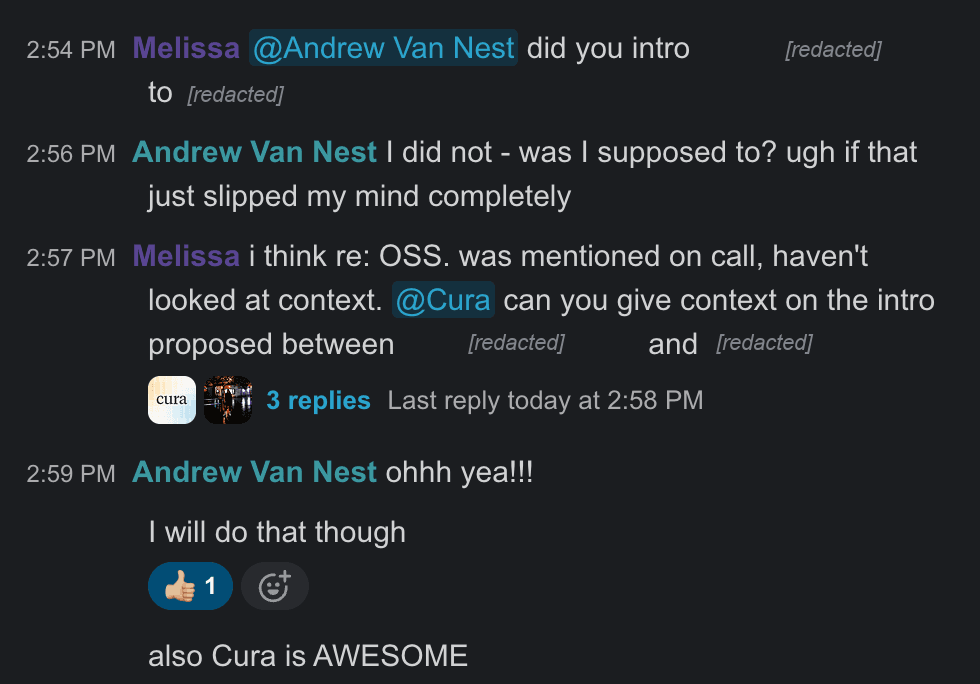
She tagged @Cura in Slack, and two seconds later: the exact context. Open-source licensing. Why the intro had come up. Where in the call it had been mentioned.
Andrew, looking back through it: “ohhh yea!!!”
“Great example of something smart said on a call and lost forever — until Cura haha.”
Why Melissa stopped trying to build this internally
For two years prior to implementing Cura, Melissa had tried to build an internal solution. With the help of engineering resources, a viable Slack bot was developed. But as the portfolio grew, the in-house build was having a hard time navigating context. It was Q&A as opposed to a fully unified orchestration. She realized something more sophisticated would be required.
“It became time consuming to maintain and upgrade — 15 to 20 minutes most days fiddling with it to kinda work.”
“It’s quite difficult to weave all these various threads of communication, relationships, questions, asks, follow-ups, metrics.”
So she stopped.
What she’d been trying to build, Cura did out of the box. No more spending time on upkeep, no more wasting time fiddling.
Portfolio management without the busywork
See Cura running on your own portfolio.
Book a demo and we’ll load your portfolio into Cura. The reviews, the KPIs, the signals you can’t afford to miss — all in one place.
Book a Demo